Never Run Out of Paper: How Supply Management Takes Stock-Tracking Off a Building Manager
The restroom with no paper towels is never noticed until it happens, and the fix is a system, not a reminder.
October 16, 2026 · 3 min read
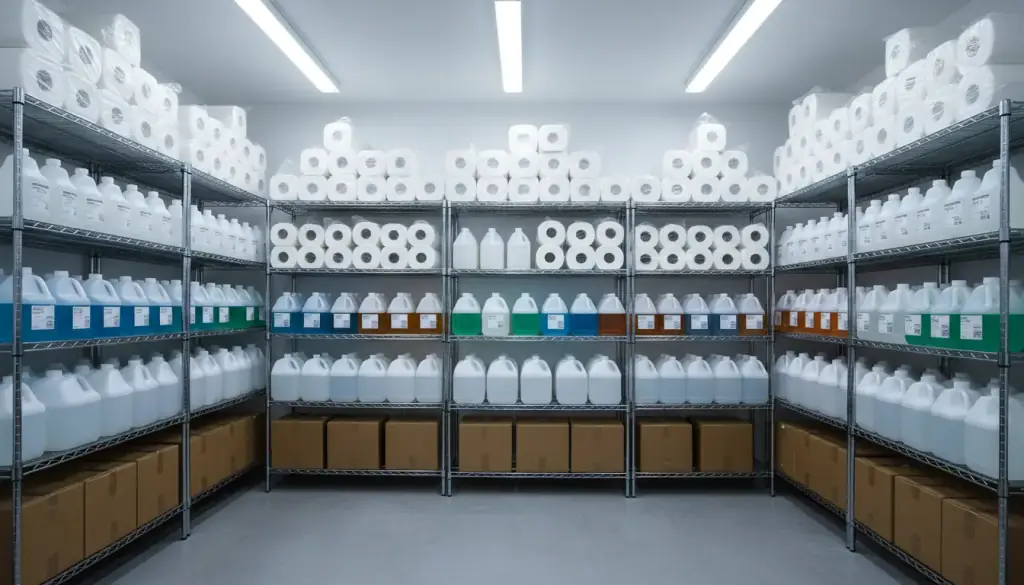
There is a kind of problem in building management that nobody thinks about until it goes wrong. The restroom runs out of paper towels on a busy Monday. The break room has no liners. A visitor asks the front desk for tissue. None of these are major events, but each one is noticed, and each one ends up on the building manager's desk. They are also entirely preventable.
Automated Maintenance Services (AMS) offers paper product management for exactly this reason. This post explains how supply management works in a commercial building, what goes wrong without it, and what to ask if you are thinking about handing it off.
Why buildings run out in the first place
Supplies run out because ordering is nobody's actual job. It is a small task that lands on whoever is nearest: the office manager, the maintenance lead, the receptionist. It gets done when someone remembers, and it gets forgotten when something louder is happening. Meanwhile usage is hard to predict. A building hosting an event, a busy flu season, or a new tenant can use far more in a week than the same space did last month.
- Ordering is a side task with no owner.
- Usage changes with events, weather, and occupancy.
- Storage is limited, so people avoid buying ahead.
- Several people order from several places, and no one sees the whole picture.
- Nobody counts what is left until it is gone.
What supply management looks like
With supply management, the cleaning contractor takes responsibility for the supplies that restrooms and break rooms depend on: paper towels, tissue, liners, soap, and related items. According to AMS, supply orders are placed weekly and delivered the next day, so the building does not run into shortages. The building manager no longer tracks ordering, which is the part that tends to get dropped.
The crew is already in the building and already sees which dispensers are low and which closets are running thin. That puts the people who notice the shortage in the same company that orders the refill. It is the simplest way to close the gap between the problem and the solution.
Buying in bulk changes the math
A single building usually buys supplies in small quantities at ordinary prices. A cleaning contractor that serves many buildings buys chemical and paper products in bulk. AMS says it passes those bulk purchasing savings on to its customers. That does not mean every building will save the same amount, and AMS does not publish figures, but the structure is real: bigger purchases generally cost less per unit, and someone who buys for many sites can get there faster than any one office can.
What a building manager can still decide
Handing off ordering does not mean giving up control. There are still decisions that belong to the building, and good supply management leaves them with you.
- Which products and dispenser types you want in your restrooms.
- Whether you prefer one brand style throughout or a mix by area.
- How much storage space you can offer for the stock on hand.
- Which areas, such as executive restrooms or lobby facilities, should get a different level of product.
- How you want to be told about changes in what is used.
It is worth standardizing dispensers where you can. Mixed dispensers mean mixed refills, and that makes shortages more likely. If every restroom takes the same towel and the same tissue, the crew can restock from a single shelf without checking what goes where.
Questions to ask before you hand it off
- Which supplies are covered, and which stay with the building?
- How are usage levels tracked so orders match what is actually used?
- How does the weekly order cycle work for my building, and who confirms it?
- What happens if there is an unusual week, such as an event or a new tenant?
- How are product changes handled if we want to switch dispensers or brands?
A small change that frees up real time
For a single-site facility manager, taking supply ordering off the list is a few minutes a week. For a property manager with several buildings, it is a recurring task multiplied by every site. Either way, the benefit is the same: a building that never has to be explained to a tenant. When a restroom is stocked, no one notices. That is the goal.
If you manage a building in Fargo, Bismarck, Jamestown, Minot, Detroit Lakes, Billings, or Boise and want ordering off your plate, call AMS at (701) 235-4412 and ask about paper product management alongside janitorial service.
Automated Maintenance Services, Inc., (701) 235-4412
Call (701) 235-4412More articles
Hot Water Extraction vs Bonnet Cleaning: How a Commercial Carpet Program Uses Both
The two carpet methods do different jobs, and the buildings that stay presentable use both on a schedule.
VCT, LVT, Linoleum, Ceramic and Wood: Why Each Hard Floor Needs Its Own Care Program
A single mop-and-wax routine cannot serve five floor types, and the wrong routine costs a building more than the right one.